Manage where revenue opportunities are waiting.
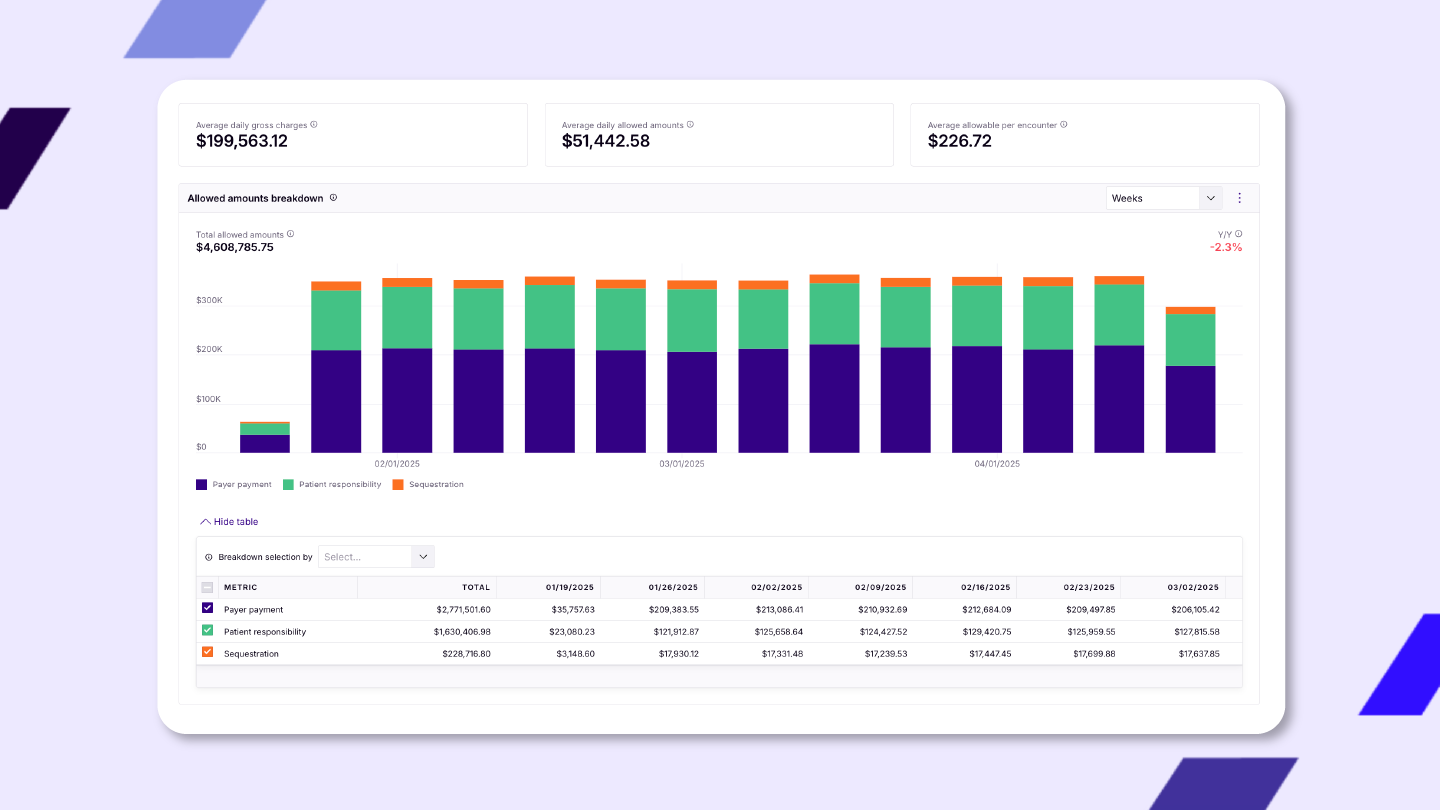
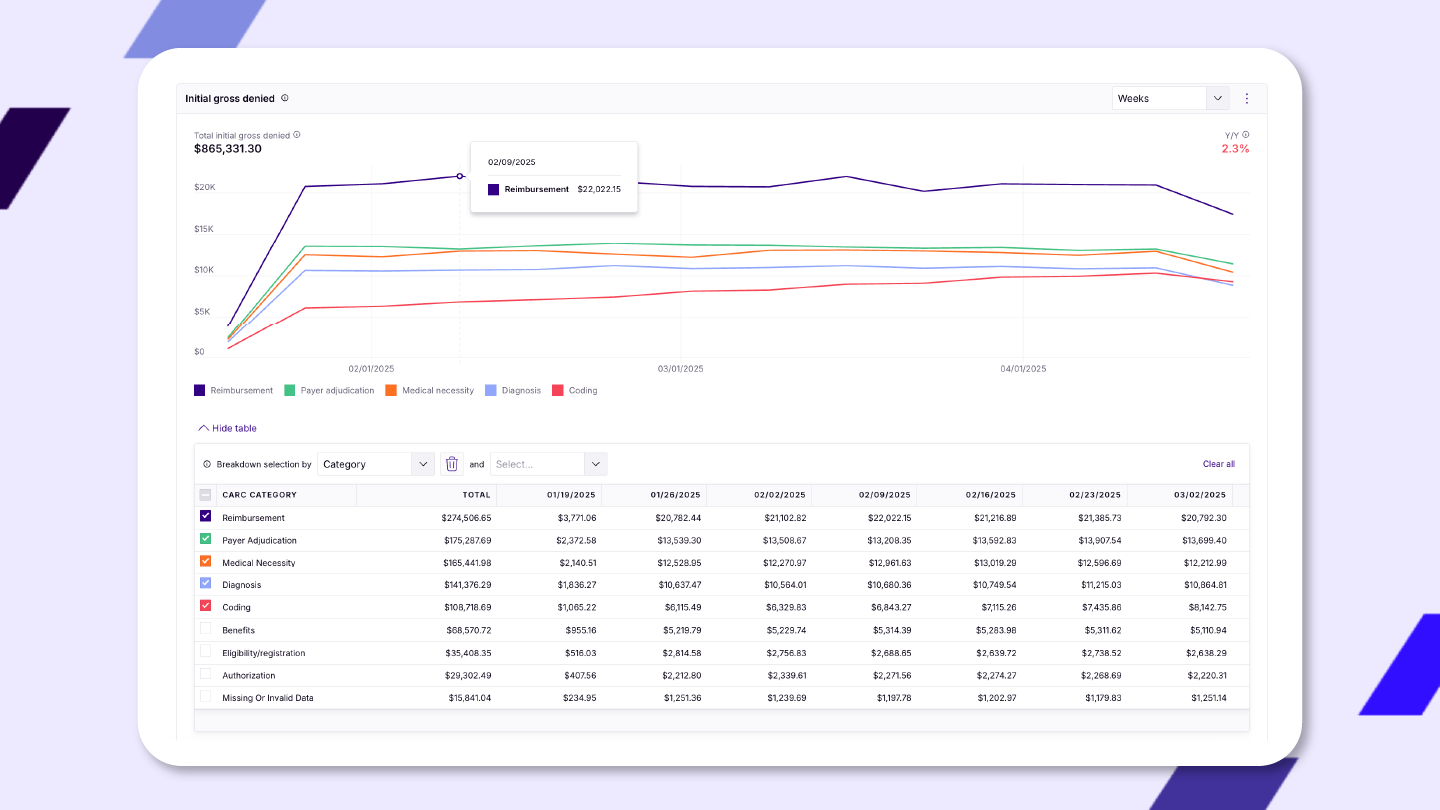
Uncover missed revenue and plan training or recovery efforts.
Within the first 90 days in accounts receivable, the collectability of accounts is 90%. Once accounts reach 90 days overdue, the chance of collecting drops to 50%. At 180 days, the chance of collecting falls to 20%. Account balances that are over a year old have about a 0% chance of collection.
Tracking how long it takes to get paid is tracking IF you'll get paid.
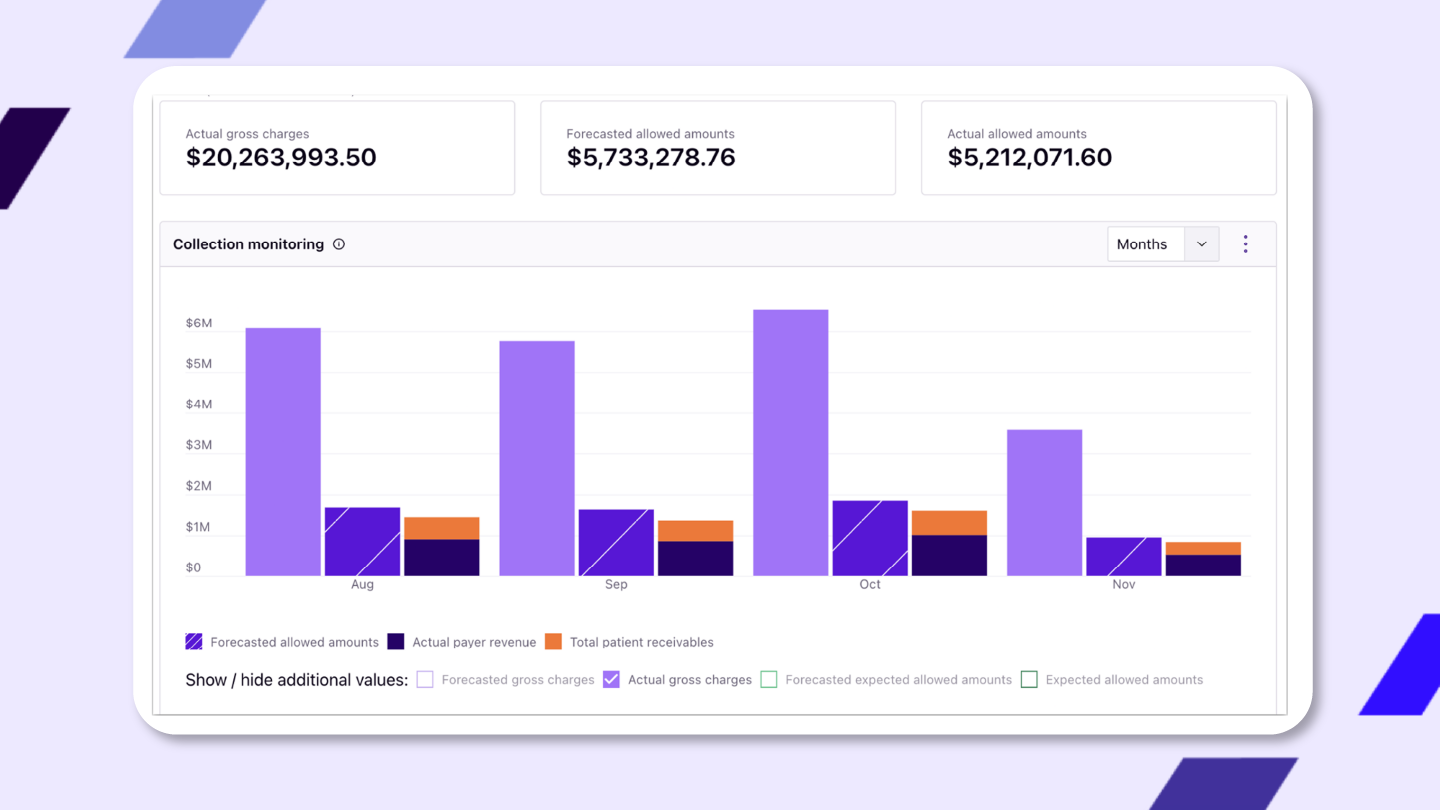
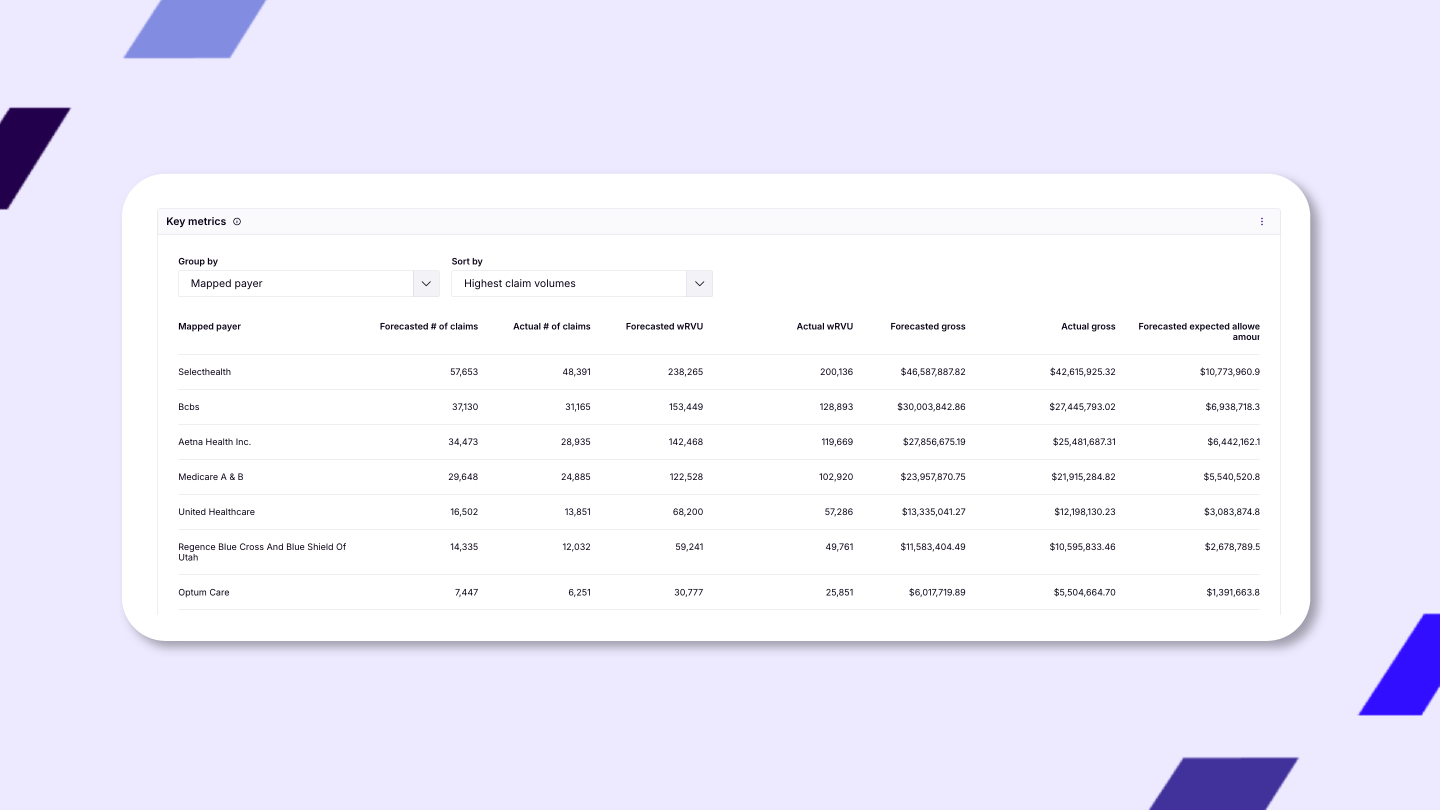
Understand the intricacies of your payer-provider relationships.
If you are seeking true change in your revenue this year, you’ll want to commit to a modern technology platform that can assist your journey. A modern platform built with the top issues of today's RCM landscape (not designed forever ago) is less of a disruption than you might think - especially the way it can increase your current revenue overall. To help you pick the right partner, your software should include the following:
Payer document discovery support
Integration with current systems
Aggregate data analyses
Claims breakdowns
Customizable reports to simplify data visualization
Claim grouping methodology
Claim analysis for systemic issue discovery
Table overviews of numerical data
Net revenue forecasting
Payer mix breakdown
Volume and seasonality forecasting
Historical and real-time reporting
Defines areas of opportunity
Suggestions to collect missed revenue
Projects net revenue based on hypotheticals
AI-powered custom reports
Constant claim watchdog
Discovery and strategic support
To effectively manage revenue cycle performance, healthcare organizations must identify and track Key Performance Indicators (KPIs) that directly impact financial health. These KPIs provide critical insights into areas requiring attention and help drive strategic decision-making.
These metrics are typically found through setting time period parameters to dictate how much information is needed to compare performance month over month, quarter over quarter, and year over year. But even though timeframes such as month-end reviews are useful for reactive strategic decisions, we encourage a more proactive strategy. Top industry leaders spend time analyzing metrics weekly, if not daily, to monitor shifts in performance incrementally rather than only as a past performance moratorium.
Remember to monitor for changes like your life depends on it — because in many ways it does.
KPI revenue impact can vary widely depending on the following metrics:
As you monitor your KPIs, keep in mind that you don’t have to do it alone — there are many software tools available to help you along the way.

Once you’re tracking your top key performance indicators you can strategically operate your practice with confidence in what’s happened last month or quarter. Monitoring revenue performance is a great way to look back on everything that has happened, but what if you used your past findings to model future revenue impact?
Creating a predictive model for revenue involves leveraging historical data and various analytical techniques to forecast revenue trends. This allows healthcare organizations to anticipate financial performance, optimize resource allocation, and make proactive strategic decisions well before negative impact can be felt.
And with Rivet, you can start tracking any and all of your KPIs now.
"Rivet is a platform I couldn't live without."
"We immediately saw ROI through time savings with Rivet through the automation of numerous manual processes, resulting in reduced accounts receivable days and the identification of underpayments. And Rivet integrates seamlessly with Athena, making Rivet a platform our team could never live without."
Sherrie Lewis, Director of RCM
Boulder Centre for Orthopedics & Spine
“Rivet gives an inclusive view of all of our claims in one place, at one time. It truly is the one-stop shop for revenue analytics.”
“There are a thousand reasons to use Rivet, but the main one that we enjoy is the transparency into our claims. In seconds we’re able to deep dive into our denials, underpayments, overpayments, and claim trends. The data is all there and I can analyze it without having to spend any manual effort.”
Amanda Hager, RCM Specialist
Generations Family Practice
"Rivet’s software is a necessity to manage medical practices of any size."
“The analytics and data aggregation tools in Rivet are great: we can sort and display claims data in ways you’d never be able to do on your own. It’s awesome. Rivet’s software is a necessity to manage medical practices of any size.”
Peggy Harris, CFO
Pediatric Specialists of Virginia.
Rivet Revenue Diagnostics does more than manage KPIs. Gain a confident picture of your financial health in real-time with customized analytics, reports and net revenue projection dashboards. Explore the financial impact of your underpayments and denials, removing future denials with our robust AI powered denials prevention engine.
Where other software stops, we begin. Optimize your KPI management now.

The most important healthcare Revenue Cycle Management (RCM) KPIs are Days in Accounts Receivable (A/R), Net Collection Rate (NCR), and Claim Denial Rate. These metrics determine the speed of cash flow, the efficiency of reimbursement, and the accuracy of billing. High-performing practices typically maintain <40 days in A/R and a net collection rate >95%.
The top 5 Key Performance Indicators (KPIs) in healthcare Revenue Cycle Management (RCM) are Days in Accounts Receivable (A/R), Net Collection Rate, Claim Denial Rate, Clean Claim Rate, and Cost to Collect. Monitoring these metrics ensures faster payments, higher revenue capture, and efficient operations. Top 5 Healthcare RCM KPIs: 1) Days in Accounts Receivable (A/R): Measures the average number of days it takes to receive payment after services are provided, with a benchmark of 30–40 days. 2) Net Collection Rate: Represents the percentage of allowed revenue actually collected after contractual adjustments and write-offs, with a benchmark of 90% or higher. 3) Claim Denial Rate: Tracks the percentage of claims denied by payers, with a target under 5% to minimize lost revenue. 4) Clean Claim Rate: Measures the percentage of claims submitted and accepted on the first attempt without errors, ideally higher than 95%. 5) Cost to Collect: Determines the overall expense to collect payments, identifying efficiency improvements in the revenue cycle.
It’s time to gain visibility into revenue opportunities, so that means it’s time for Rivet.