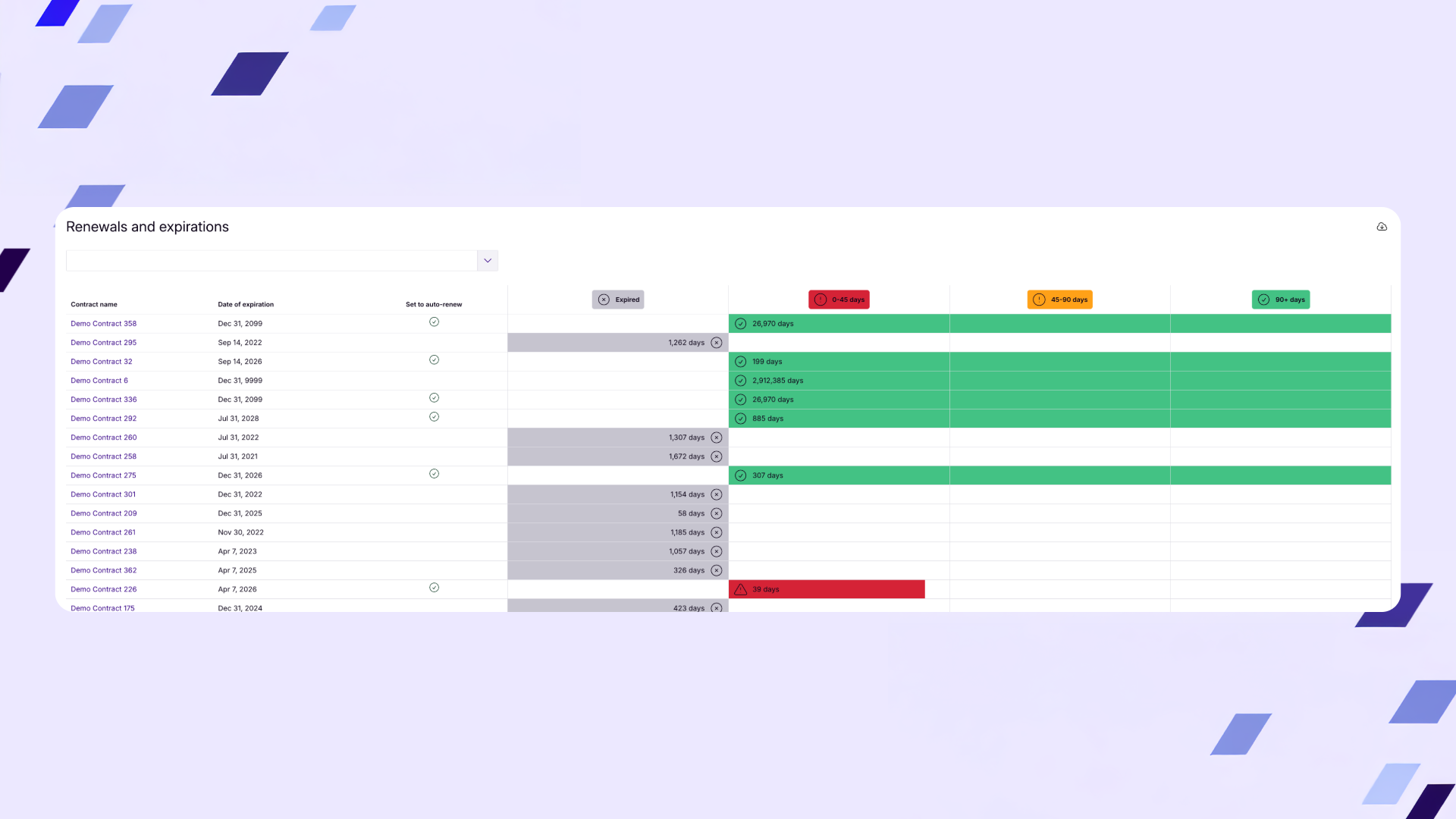
Manage contract terms, agreements, fee schedules, renewal timelines, etc.
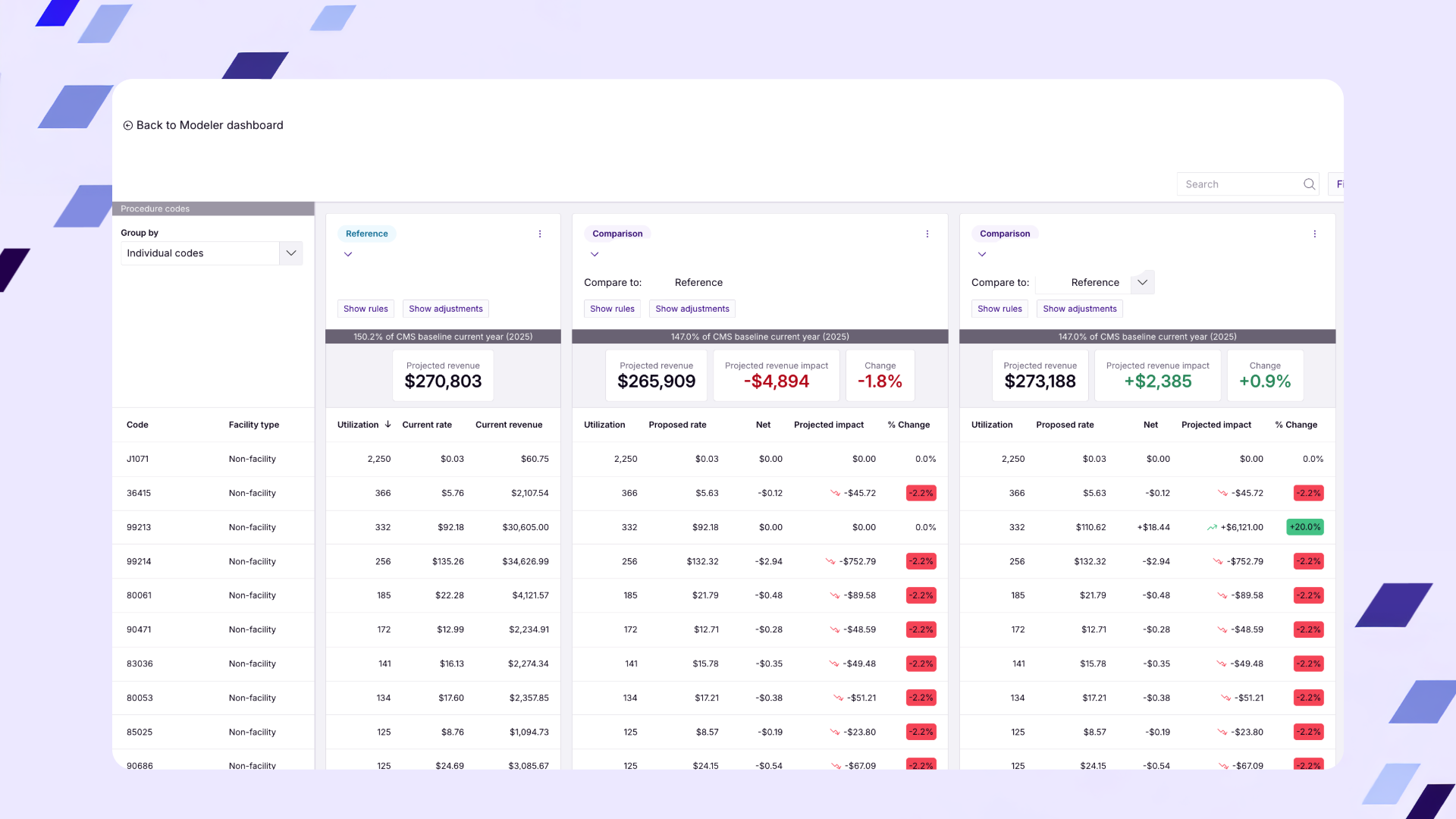
Model revenue impact of potential fee schedule changes in just a few clicks.
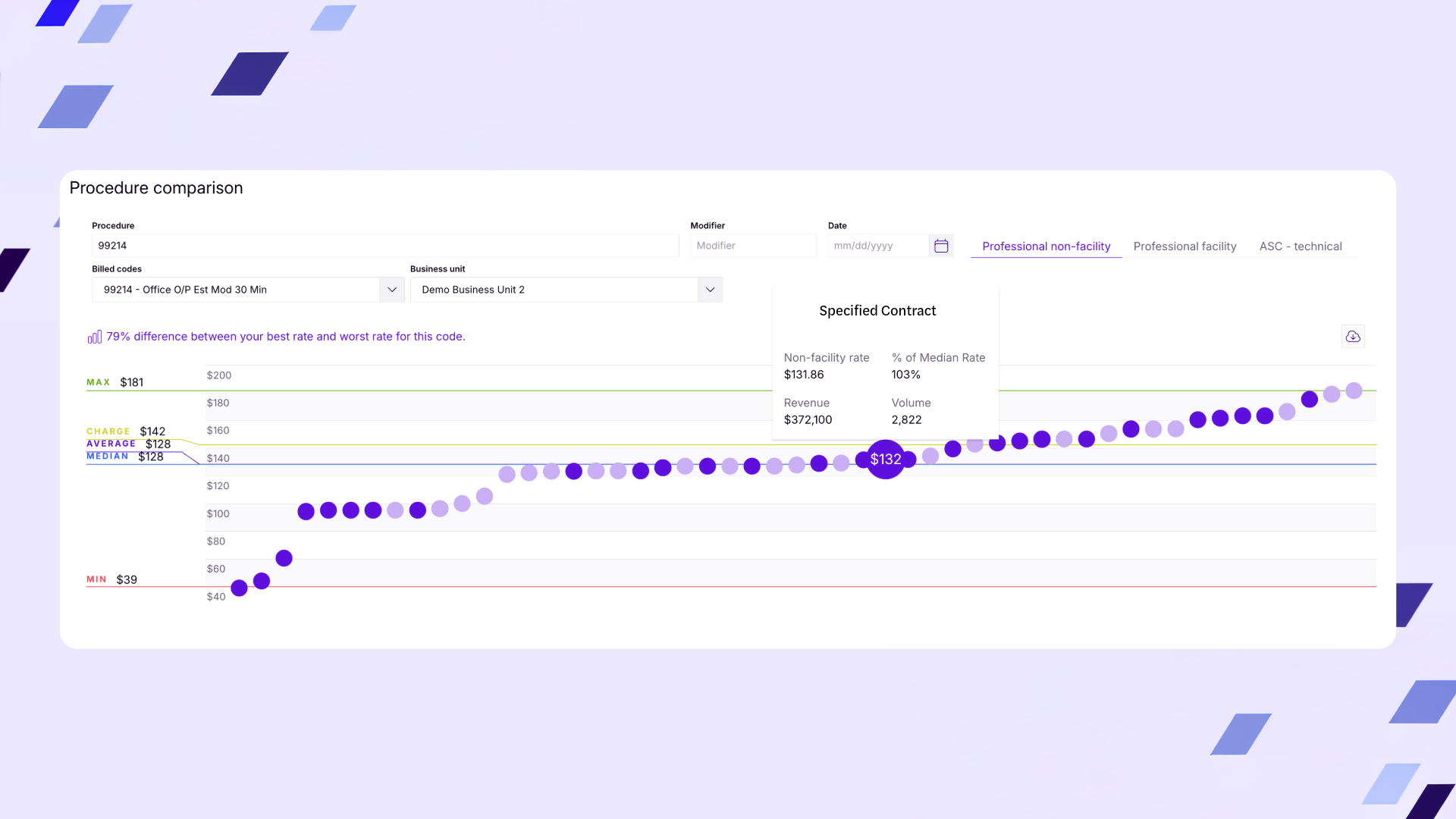
Compare contracted amounts per procedure code.
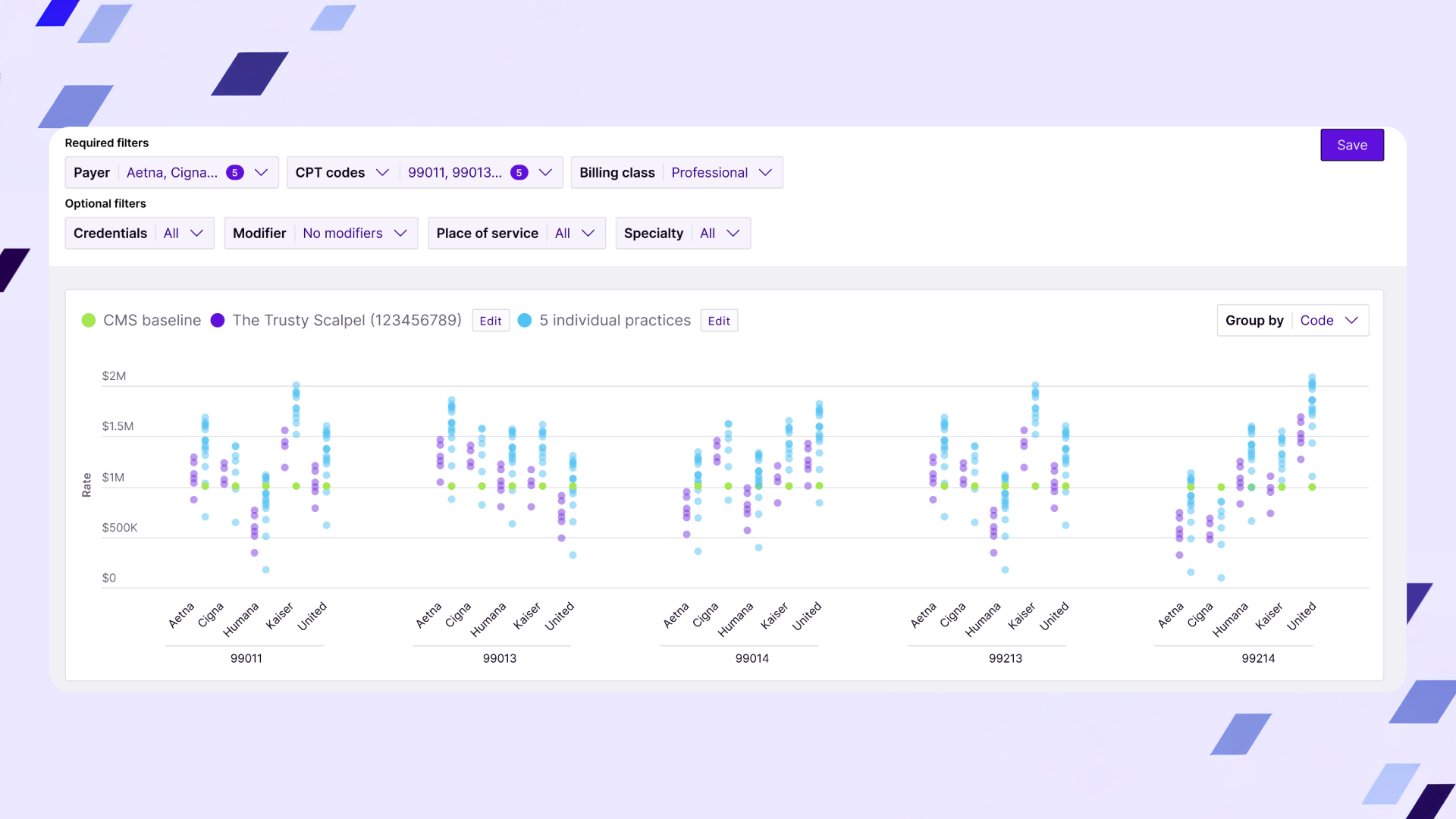
See where charge prices can be adjusted to align with current or future contractual payments.

Payer document discovery support
Integration with current systems
Procedure code comparison
Claim analysis for systemic issue discovery
Data-backed negotiation simulation of revenue impact
Overview of maximum, average, median, and minimum allowed amounts
Payer mix comparison
Easy view of all contracted rates simultaneously
Payment variance management workflows
Customizable rules to simplify data visualization
Easy variance explanations for appeal reasoning
Data filtering for manageable workflows
Measured revenue and volume of your services
Renewal timeline tracking
Easy-view contract terms
Centralized payer contact information
Historical contracted rate storage
Rate change and revenue impact modeling
Payment terms, escalators, lag time management
Always-on payment variance auditing + detection
Market benchmarking assistance
Responsive, U.S. based support




"The contract negotiation preparation tools are my favorite part of Rivet, " Shannon Young, Bluegrass Orthopaedics (BGO) business services director said.
"We used to work on a contract negotiation for months, if not longer. But with Rivet we can get negotiation preparations done so much quicker. What used to take 1-2 months can now be done in less than a week. There’s no way we could prepare for negotiations that quickly without Rivet."
At the time of BGO's interview with Rivet, they had 3 contract negotiations in various stages: one just sent, one in progress, and one successfully negotiated.
"We had a consulting firm that did our negotiations for us, but with Rivet we saw better places for negotiation and we could do a better job at preparing for negotiation." “If you're conscientious, ” Young said, “Rivet does anything you need.”

"We negotiated 20% higher than where we had been," said Jennifer Davison, CEO of Vero Orthopaedics.
"We have major negotiation leverage, thanks to Rivet. We were able to go to payers when contracts were up and show our rates side by side. We wouldn't renew with them unless we got better rates and we negotiated 20% higher than where we had been."

“It’s good to know if we are being paid the wrong amount and nobody knows it,” said Peggy Harris, CFO of Pediatric Specialists of Virginia.
“Rivet Payer Performance is where we get the most distinct return on investment. It’s good to know if payers are paying us the wrong amount and nobody knows it.”
Rivet Payer Performance simplifies and strengthens payer contract management, negotiation, rate comparison, and contracted rate variance revenue recovery in record time. Model the best terms for a new contract, compare rates to optimize reimbursement rates, and assess claim data. Gain key insights for your claims, your revenue, and your pricing.
Where other software stops, we begin. Optimize your contracted reimbursement now.

It’s time to prepare for contract negotiation, so that means it’s time for Rivet.










.png?width=1920&height=1080&name=New%20Cover%20Ebooks-2%20(1).png)